ACTA ACCLA, August 2004
THE COUNTERMARKS FOUND ON ANCIENT ROMAN COINS: A BRIEF INTRODUCTION
Richard Baker
Adapted with minor modification from SAN, XV, 52-58, 1984
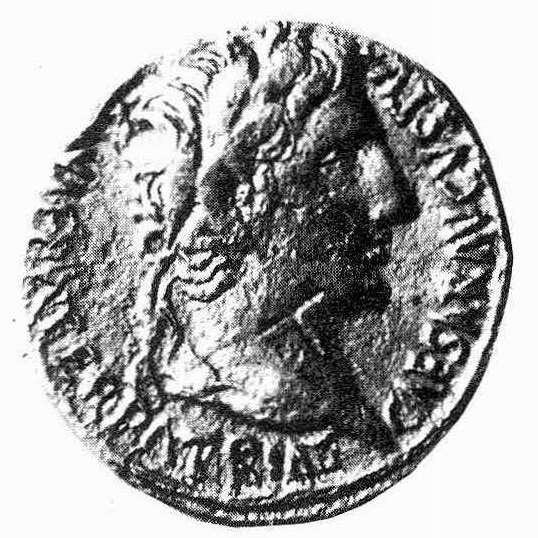
Figure 1. Obverse of a silver denarius of Augustus. Mint of Lugdunum. Circa 2 BCE - 4 CE (possibly later). Diameter 18 mm. Note the "T" punchmark upon neck and jaw.
During the many years that Rome ruled the Mediterranean World, a number of Roman coins were countermarked by various governing authorities and even by usurpers.
As one or more of these countermarked coins is almost certain to be encountered by anyone seriously pursuing the field of Roman coinage, it is surprising that there is not at least one comprehensive text available on the subject. Instead, the interested person must turn to the introduction in such general works as Coins of the Roman Empire in the British Museum (the most quoted source), Roman Imperial Coinage, and to a number of articles and monographs discussing various aspects of the subject or particular groups of countermarks [ 1 ].
The definition of a countermark (sometimes referred to as a counterstamp) has, for unknown reasons, been avoided by most writers on the subject. This may have caused some past confusion with such terms as "punched," "counterpunched" and "overstruck." So let us begin by saying, a countermarked coin is one which has had a secondary stamp impressed upon it at some time subsequent to its original minting [ 2 ]. This countermarking could be done to a relatively new coin or to a coin which had been in circulation for many years.
Because of the need for anyone interested in Roman coinage to know when he or she is observing a countermarked coin, to know the purposes for the use of such marks and to encourage further investigation when such marks are encountered, I have chosen to introduce this subject to my readers in outline form. For this purpose, after a brief introduction, I have listed some of the most interesting and illustrative types of Roman countermarks together with their striking authority and purposes for their use.
The coinage of the period of the Roman Republic seldom contains countermarks. There are some sporadic instances of countermarks being placed upon Republican coins still in circulation during the "Empire." By the Empire I refer to that period from 27 BCE until 476 CE when Rome was ruled by a succession of Emperors.
Instead of countermarks the coinage of the Republic often contained bankersmarks, also called punchmarks. This term concerns the practice of placing test cuts or "punching" incised letters or emblems upon the surface of a coin by merchants and moneychangers to determine whether a coin was pure metal or plated. They are found primarily on the gold and silver issues.
Roman countermarks as such did not come into use until the introduction of the imperial era by Augustus. There were several reasons why a Roman coin might be countermarked during this period, and various authors give divergent views on the matter. By "pooling" these views one comes up with the three following major categories:
CATEGORY 1.To extend the geographical area in which the coin would be accepted as legal tender.
CATEGORY 2. To continue in use a coin which had been in circulation for a considerable period of time.
CATEGORY 3.To designate a new authority usurping the coins of another for their own use.
Each of these categories has a number of subdivisions, several of which I have designated under each category by capital letters.
CATEGORY 1.
A. Countermarking by imperial authority a coin of the mint of Rome or Lugdunum, [ 3 ] so it could be used as legal tender in a province by the Roman legions stationed there. The area usually concerned was the German frontier, along the Rhine, during the wars of the first two decades CE.
| Typical Countermarks of Category IA: |
 | Augustus. |
 | Imperator Augustus or roughly, the emperor Augustus. |
 | Tiberius. |
 | Tiberius Imperator. |
 | Tiberius Augustus. The name "Augustus" originally bestowed as a title of honor in 27 BCE. Later became hereditary for all male members of the Julio/Claudian family upon their accession to the throne. |
 | Monogram for the name Caesar, not Julius Caesar however. Until recently it was thought that all use of this monogram referred to Germanicus Caesar (died 19 CE). It is now generally thought to be a title of authority employed by Tiberius Caesar [ 4 ]. |

Figure 2. As of Augustus. Mint of Lugdunum. Circa 10 BCE - 5 CE. 27 mm. Reverse showing the altar at Lyons dedicated to Rome and Augustus. Countermarked with  for Tiberius.

Figure 3. As of Augustus. Mint of Rome. Struck 7 BCE by the moneyer P. Lurius Agrippa. 27 mm. Obverse showing the monogram for the name "CAESAR." Countermarked during the first two decades CE for distribution on the German frontier, along the Rhine.
B. Countermarking done in the name of the Roman governor, Legate, proconsul or prefect in charge of a particular province. Whether this was done for officially sanctioned reasons or for personal propaganda is not certain. They generally appear on coins of the first three decades CE, and should not be confused with Category 3A.
| Typical Countermarks of Category 1B. |
 | Possibly C. Galerius, prefect of Egypt in 19 CE under Tiberius. |
 | L. Apronius, proconsul of Africa in 20 CE.5 |
 | Monogram for P. Quinctilius Varus, Governor of Germany in 9 CE under Augustus. Varus was a distant relation of Augustus and had served with great distinction as Governor of Syria. In 9 CE due to his under estimating his enemy he was ambushed and destroyed along with his entire command of Legions XVII, XVIII, and XVIIII in the Teutoberg Forests of Germany. Over 15,000 men perished. The numbers XVII, XVIII and XVIIII were never again to be used by Roman Legions. It was to be Augustus' greatest military defeat. |
 | Monogram for Germanicus, commander of the Legions in Germany from CE 14-16 under his adoptive father, Tiberius |
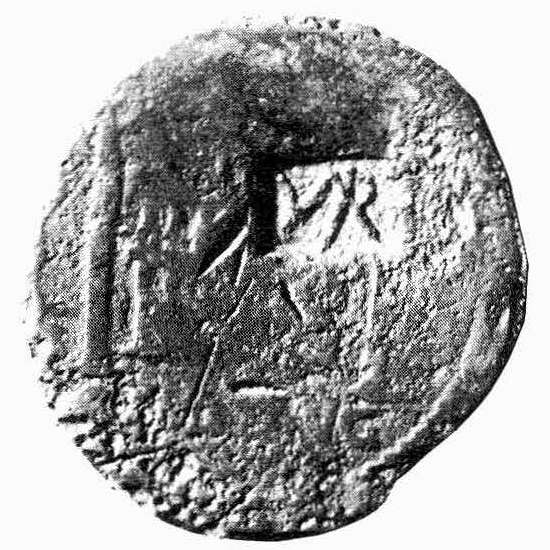
Figure 4. As of Augustus with altar reverse. Mint of Lugdunum. 27 mm diameter.  monogram for P. Quinctilius Varus. Countermarked circa 9 CE for use by the Legions stationed in Germany.
C. Countermarking local "provincial imitations" of Roman coinage to give official sanction to them by the government of Rome, or its legal representatives. These imitations are usually Gallic, Hispanic or British in origin and are most frequently copies of the coins of Augustus, Tiberius and especially Claudius.
| Typical Countermarks of Category 1C. |
 | Probatus, meaning "approved." |
 | Local variant of above, peculiar to Britain. |
 |
Probavit, Imperator. Two separate countermarks combined on one coin to produce the statement "with Imperial approval." |
 | BONUS, meaning "good." Another variant similar to probatus. |
 | Tiberius Augustus (Tiberius Claudius Drusus) i.e. the Emperor Claudius. Struck mainly upon provincial imitations of sestertii of Tiberius, Caligula and of Claudius himself. |

Figure 5. (Obverse & Reverse of Same Coin) Gallic imitation of a sestertius of Claudius. Circa 41-65 CE. 35 mm. Obverse shows the PROB countermark for "PROBATUS." Reverse shows the partial flattening of the coin due to the force of the countermarking. The full reverse legend, in four lines should read: EXSC / OB / CIVES / SERVATOS.
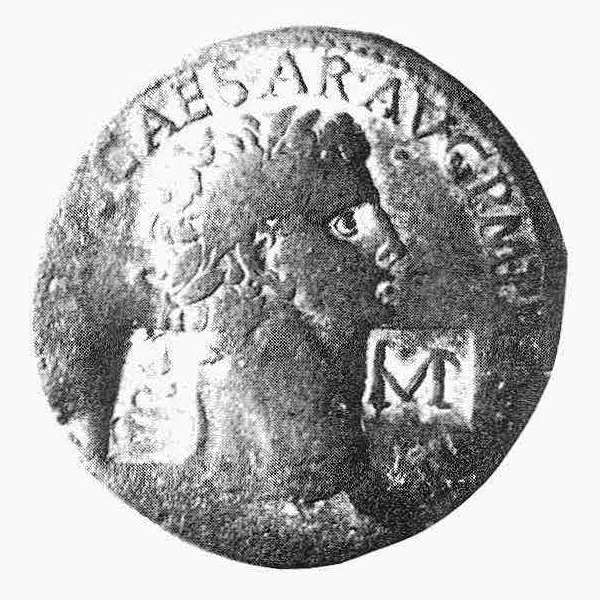
Figure 6. Another Gallic imitation of a sestertius of Claudius. 35 mm. Obverse shows the use of two different countermarks. The first, PRO (for Probatus) is here combined with (for imperator) to form the saying "Probavit Imperator."

Figure 7. Dupondius of Antonia, the mother of Claudius. Possible colonial imitation of official Roman issue. Struck circa 41-54 CE. 32 mm. Obverse shows the countermark BON, which is the abbreviation of "BONUS," meaning "good." Reverse showing the usual flat area caused by countermarking.
CATEGORY 2.
A. The coins in this category are usually in a worn condition. In this condition countermarking served to downgrade the value originally placed upon it.
| Typical Countermarks of Category 2A. |
 | Dupondius, struck upon worn specimens of sestertii and downgrading their value by half. |
 | As. Struck upon worn specimens of dupondii and downgrading their value by half.6 |
B. This would include countermarking the coins of one's predecessors still in circulation to give them a "fresh" guarantee. One reason this was considered necessary was because the office of emperor and of the imperial majesty was still a relatively new institution in the Rome of the first century CE. Legally it rested upon shaky ground. Although the Senate of Rome abandoned the Republic by relinquishing supreme power to Augustus, it still technically was not an hereditary office. The first emperors of Rome found it necessary to remind the populace of their authority while at the same time creating a visual link with their predecessors. By countermarking the coins of their predecessors they saved the time and expense of minting new coins while still conveying the all important message--namely who controlled the power.
| Typical Countermarks of Category 2B. |
 | Here we have the commonest of all the early Imperial countermarks. However, not all the authorities agree on what the letters mean. It was struck upon the base metal coinage during the first eight to ten years of Nero's reign when only gold and silver was minted in his name from the mint of Rome. Speculation as to why it was used and what its translation is varies according to which theory one adheres to. |
These are the two most common translations:
1. Nero Claudius Augustus Probavit. Roughly, "with the approval of Nero Claudius, the Augustus."
2. Nero Claudius Augustus Populo Romano. Roughly, "from Nero Claudius, the Augustus, to the people of Rome."
In the first case it is the revalidation of the coins of Nero's three immediate predecessors (Tiberius, Caligula and Claudius).
But in the second instance it is a "congiarium," or public dole given by Nero sometime after his succession to the throne. Originally in the form of wine or grain it later developed into the custom of monetary donations given by the emperors to the populace of Rome.
Since the greater majority of those specimens found to date are from either the mint of Rome or Lugdunum, and also show very little wear to necessitate countermarking, I hold with the second of the two translations.

Figure 8. Sestertius of Claudius from the mint of Rome (obverses of different coins). Circa 42-54 CE. Obverses show the NCAPR countermark of Nero. Also pictured is a dupondius of Antonia from the mint of Rome, likewise showing a NCAPR countermark.
CATEGORY 3.
A. In times of revolution the names, monograms, or mottos of revolting generals and legions were countermarked by their adherents upon the available coinage. Quite frequently this was done upon the coinage with the portrait and titles of the emperor the revolution was against. For all practical purposes this category refers to the revolt of CE 68/69 against the emperor Nero and his immediate successors. Within that short time span Rome was to witness five Augusti in rapid succession. All of them claiming the imperial authority; only the last, Vespasian was able to hold it.
| Typical Countermarks of Category 3A. |
 | Populus Romanus - The Roman People. This countermark was used by the rebels in Gaul under the leadership of Julius Vindex during the months of March through June of 68 CE. Used mostly upon dupondii and Asses. |
 | Senatus Populusque Romanus - The Senate and people of Rome. Same as for PR. Both were generally struck across the portrait (if on a coin of Nero) so as to disfigure it. By the use of this countermark Vindex was not disavowing his loyalty to Rome and its Senate, but to the contrary. It was only a repudiation of allegiance to the Emperor Nero, calling upon both the senate and people of Rome to name a worthy replacement as Emperor. |
 | Greek lettering for the name Galba. Issued in lower Moesia upon the unorthodox (colonial imitation) sestertii, dupondii and asses of Nero. Used from April until about mid July, 68 CE. Like the countermarks of Vindex, it was struck across the portrait to disfigure it as much as possible. |
 | Monogram for OTHO IMPERATOR. Used from January until early April 68 CE. |
 | VITE monogram for Vitellius. Used from January until early April 68 CE. Struck upon the sestertii from the mint of Lugdunum as well as upon unorthodox Gallic issues. |
 | Imperator Vespasian. Used by the followers of Vespasian at Antioch, upon Cistophoric silver pieces7 and upon old Republican denarii.8 June until July(?) 69 CE. |
 | VESPA monogram for Vespasian. Used on dupondii and As of Nero from the mint of Lugdunum. From June until possibly December 69 CE. |

Figure 9. Obverse of a very worn colonial piece of Nero from Antioch. Circa 65-68 CE. Note that the PR countermark has been struck deliberately across the features of Nero, to deface his image.
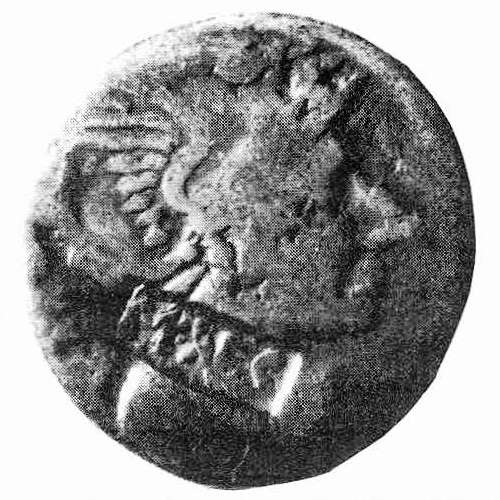
Figure 10. Republican silver Denarius of L. FLAMINIUS CHILO struck circa 106-105 BCE. The obverse has been countermarked by the adherents of Vespasian (circa 69/70 CE) with the motto  for "Imperator Vespasian." This countermark was placed upon the coin 175 years after its original minting! This gives some indication as to the life span of particular coin denominations.

Figure 11. As of Nero. Mint of Lugdunum. Struck between 66 and 68 CE. Obverse shows the  (VESPA) monogram countermark for Vespasian used in 69/70 CE. It usually appears only on coins from this mint.
It is worth noting here that only upon the coins countermarked by the followers of Vindex or Galba did they strike upon the features of Nero deliberately to deface his portrait. This was because both Vindex and Galba were in revolt against Nero, whereas when Otho, Vitellius and Vespasian revolted, Nero was already dead. Ostensibly these last three named were not in revolt against Nero, only against his hated "usurpers" of power. By pairing their monograms next to the still visible portrait of Nero they were in effect trying to create that "visual" link with the legitimate, but now extinct, Julio/Claudian dynasty.
I would like to include here two unusual legionary countermarks which because of the coins they appear upon as well as their content, are linked to both the Category 3A above as well as the following Category 3B. They are:
 |
Roman numeral ten with a bar across the top or bottom. Struck for the Legion X Gemina, stationed in Pannonia. It was upon coins of Nero from the mint of Lugdunum, but only after Nero's death. The Legion took no active part in the revolt of 68 CE. In July of that year they were reassigned to the province of Spain by the Emperor Galba and took no active part in the struggles for power which followed. The stamp was used sometime within the year 68/69 CE. |
 |
Club of Hercules(?) suspended above LVI which most likely stood for Legion VI, Victrix, from Spain which was the personal legion of Galba and was the first to declare for him. It has been found on several Gallic imitation sestertii of Claudius, as well as upon several other types. It may have originally been used to advertise the cause of Galba, but since the majority of the coins apparently available at the time were of the Emperor Claudius they were not defaced as were the coins with Nero's portrait. |

Figure 12. As of Nero. Mint of Lugdunum. Struck circa 66 to 68 CE. Obverse showing the  countermark which stands for the Legion X, GEMINA, which was stationed in Pannonia during the revolt against and subsequent overthrow of Nero. It was probably employed during 68/69 CE.
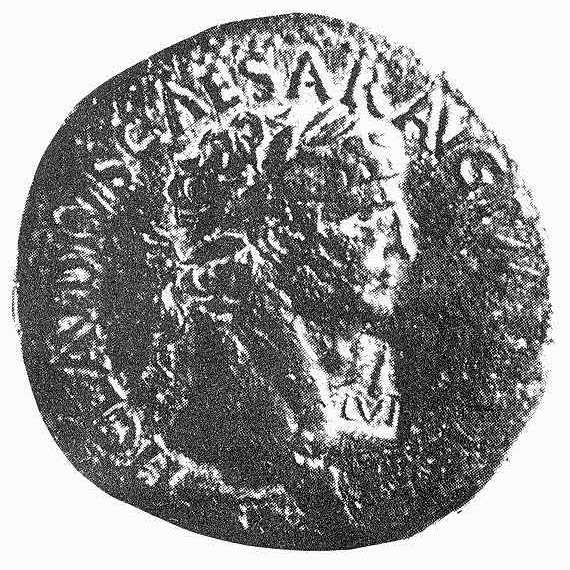
Figure 13. Another Gallic imitation of a sestertius of Claudius, struck 41-65 CE. Obverse shows the unusual countermark  . It probably stands for the Legion VI, Victrix from Spain.
B. Marking the "Local Colonial" coins of the provinces in which the Roman Legions were stationed with "official " Roman countermarks or with semi-official "Legionary" countermarks. This was done in order to convert them into legal tender for use by the legion stationed in each particular area.
| Typical Countermarks of Category 3B. |
 |
Legion X, Fretensis. Found primarily upon the local coinage of Judaea & Samaria. They are primarily connected with the Jewish wars of 66-73 CE and the following Roman occupation. There are several other well known countermarks connected with this legion. They are probably the most widely sought after legionary countermarks because of their historic interest of the tenth legion to collectors of both Jewish and Roman coins.9 |
 |
This is one of the commonest of all Roman countermarks, either an oval or a square with a laureate head within, usually facing to the right. The head is generally intended to bear the features of the reigning emperor, but in most cases is too small to accurately identify. It is almost always found on the colonial coinage of the Roman Empire. Very old and worn coins, or coins bearing the features of recently deceased imperial family members are most frequently countermarked. |
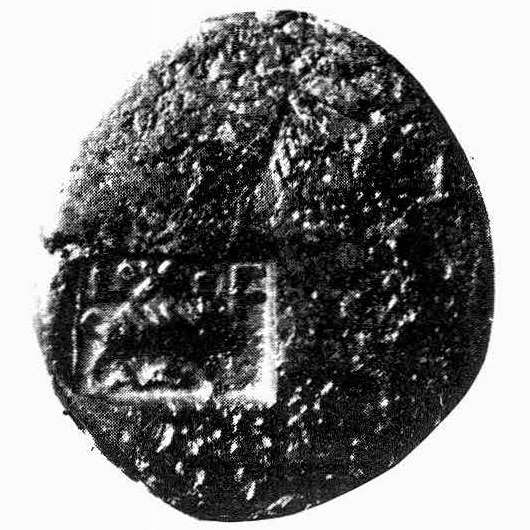
Figure 14. Colonial coin of Domitian from Syria. Circa 70-96 CE. Reverse shows two countermarks. The top one is struck vertically and represents a Roman galley with oars, sailing to the right. The larger countermark shows a wild boar with a dolphin beneath, and the letters L•X•F above. The letters stand for the Legion X, Fretensis. The galley and the dolphin both allude to the famous naval battle of 36 BCE where the Tenth Legion under Agrippa destroyed the forces of Gnaeus Pompey off the Coast of Sicily. The nickname Fretensis is taken from "Fretum Siculum," which loosely translates to the Straits of Sicily, which were located off the Cape of Naulocus, where the naval engagement occurred.
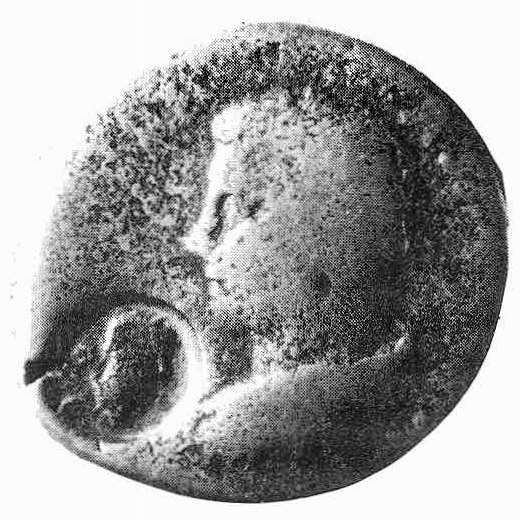
Figure 15. Colonial coin of Maximus as Caesar. Struck between 235 and 238 CE. Obverse countermarked with a small laureate head of Gordian III (238 to 244 CE).
C. The reverses of coins of Category 3B. Here the "official" coinage of Rome or its officially sanctioned colonial coinage has been countermarked by various "colonial" cities in order to appropriate the coinage for local use.
| Typical Countermarks of Category 3C. |
 | Radiate head of the god Helios(?) struck upon official sestertii of Rome of the early empire. Generally believed to have been applied in the eastern portion of the empire. |
 | Decreto Decurionum . . . by decree of the town Decuria (or Council). Quite often found upon the "as" of Nemausas of Augustus and Agrippa, as well as upon Tiberian coinage. |
 | TVR monogram for the city of Turiaso, Spain. |
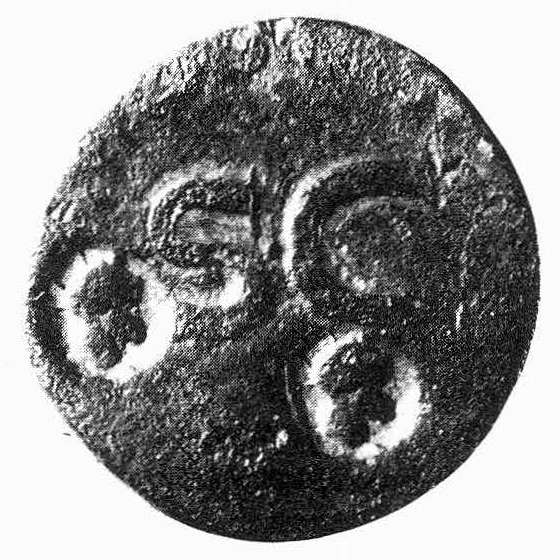
Figure 16. "Senatorial" Sestertius struck for Augustus in Rome in 16 BCE by the moneyer C. ASINIUS GALLUS. Reverse shows two countermarks of a radiate head of Hellos, a Syrian deity akin to the Roman Apollo.
D. Roman "colonial" coins with "colonial denominational" countermarks in the form of letters of the Greek alphabet. These letters were placed upon the bronze issues of various cities in the Roman East, as marks of revaluation during the periods of financial instability in the middle to late second century CE.
| Typical Countermarks of Category 3D. |
| Β | Beta - mark of value of 2. |
| Δ | Delta - mark of value of 4. |
| Ε | Epsilon - mark of value of 5. |
| Η | Eta - mark of value of 8. |
FOOTNOTES
1. Harold Mattingly, Coins of the Roman Empire in the British Museum, Vol. I (British Museum, London: 1965), xxxiii-xliii.; Harold Mattingly and E. A. Sydenham, The Roman Imperial Coinage, Vol. I (Spink & Son, Ltd., London; 1968), pp. 12-15.
2. Milne, J. G., Greek and Roman Coins and the Study of History, published by Greenwood Press (Westport Connecticut: 1971), Chapter IX, "Countermarks". This is one of the very few references which define a countermark.
3. Sutherland, C. H. V., The Roman Imperial Coinage Volume 1. (Spink & Son Ltd., London: 1984) pp. 27-29. For extensive periods of time during the Julio/Claudian dynasty (27 B.C. - 68 A.D.) the official mint of Rome was assisted by the establishment of an auxiliary mint in the west, generally believed to be the city of Lugdunum, Gaul.
4. Kraay, C. M., The Behavior of Early Imperial Countermarks plate VI. In Essays in Roman Coinage Presented to Harold Mattingly, published by Fotokop Wilhelm Weihert K. G. (Germany: 1979) Chapter VII, pp. 118-122.
5. Mentioned on numerous occasions in Tacitus The Annals published by the Everyman's Library (New York: 1922).
6. Essays in Roman Coinage Presented to Harold Mattingly, Plate VI, No. 7 and 8.
7. Metcalf, W. The Cistophori of Hadrian (New York: 1981), The American Numismatic Society, p. 17 #76a and plate 5.
8. Sear, D. Roman, Coins and their Values (London: 1981) 3rd Revised Edition, Seaby Publications Ltd., p. 42 paragraph 4.
9. Meshorer, Ya'akov Ancient Jewish Coinage Vol. II Herod the Great through Bar Cochba. Amphora Books (New York: 1982) Page 94, Page 196. Page 233, and plates.
ADDITIONAL REFERENCES CONTAINING COUNTERMARKS
Sutherland, C. H. V. Coinage in Roman Imperial Policy 31 B.C. - A.D. 68 (London: 1971) - Barnes & Noble, Inc. and Methuen & Co. Ltd., pages 69-70 and footnote.
MacDowall, D. W. Two Roman Countermarks of A.D. 68. Numismatic Chronicle Vol. XX, Royal Numismatic Society (London: 1960) Chapter 7 and plate VII.
Buttrey, Jr., Theodore V. Observation on the Behavior of Tiberian Counterstamps. The American Numismatic Society Museum Notes #16, American Numismatic Society, New York, 1970, pages 57-68.
Brunk, Gregory G. The Ancient Countermarks The Numismatist, Vol. 87, No. 11 and 12 and Vol. 88, No. 1(Nov., Dec. 1974 and Jan. 1975) the American Numismatic Association.
ACKNOWLEDGEMENTS
The major portion of the countermarks appearing in this article may be found in Coins of the Roman Empire in the British Museum (BMC) Volume 1, Pages xxviii through xliii. Many appear in several of the previously quoted references.
Essays in Roman Coinages Presented to Harold Mattingly Pages 113-136, lists most of the countermarks appearing in BMC including the following which appear in this article.
,
"Ancient Countermarks" by Gregory G. Brunk listed above served as source for the following.
, ,  , ,
, ,
The Numismatic Chronicle Vol. XX was the source of the following two countermarks from 68 CE.
,
I hope this brief introduction into Roman countermarks has succeeded in its purpose of giving the reader sufficient interest in countermarks, to encourage further research on the subject. I also hope one of our readers will be inspired to bring together, correlate and update the existing written material and write the sorely needed comprehensive text covering this most interesting subject. To do so will do much to bring it into its proper position of importance in the study of Rome and its coinage.
Thanks to Mr. John Donald for taking the photographs used in the article.

