

ACTA ACCLA, Updated October 2011
Ken Baumheckel Collection of Oil Lamps
By Ken Baumheckel

Lit reproduction 4-spout, 1-spout, and Herodian oil lamps
Introduction
Terra cotta oil lamps provided portable light and fire for every household in Syria and Palestine from the end of the Early Bronze Age. Oil lamps were used in the First Temple, and their importance and familiarity to the people of the eastern Mediterranean can be appreciated by their use in a number of metaphors in the Bible. David, YHWH, the tribe of Judah, God's word, God's commands, man's perspective on life, John the Baptist, and Jesus are all called "lamps." (See 2 Samuel 21:17, 2 Samuel 22:29, 1 Kings 11:36, Psalm 119:105, Proverbs 6:23, Proverbs 21:4, Luke 11:34, John 5:35, Revelation 21:23.)
Introductory note about the dating of the lamps
I have arranged the lamps in descending order beginning with the oldest, according to the best information I have on their attribution. There is considerable overlap of types, as older forms often continued to be made while new forms were being developed.
- - - - - - - - - - - - - -
Bronze Age | Iron Age | Persian - Hellenistic | Roman | Late Antiquity | References
- - - - - - - - - - - - - -
I. Bronze Age Lamps
1 - 4. Four Early Bronze Age Oil Lamps. 3300-2200 BCE.

Comment: All four of the Early Bronze Age lamps in this collection were made by hand with little or no use of a potter's wheel, have rather thick walls, and have wick rests that were made by merely indenting the rim with a tool or by slightly thumb-indenting and stretching it. This stands in marked contrast to the pronounced pinching of the rim that was used to form the wick rests of the wheel-made, thin-walled saucer lamps during the next two thousand years.
1. Early Bronze I lamp, 3-spout, 3300-3000 BCE. Cylindrical body of coarse clay with large inclusions. Very thick sides and bottom. Three wick rests, possibly formed by pressing a stick down into the irregular rim. 12 cm. wide, 6.5 cm. high. Similar to Sussman 2007, lamp 46 for size and thickness, Sussman 2007, lamp 50 for shape.


2. Early Bronze I lamp, 6-spout, 3300-3000 BCE. Coarse clay with large inclusions, very thick module, hemispherical wall profile. Six thumb-indented wick rests. 13.5 cm wide, 6 cm high. Sussman 2007, lamp 46.


3. Early Bronze Age lamp, 5-spout, 3300-2250 BCE. V-shaped wall profile. Thick module body added to separately formed bottom. Five spouts made by cutting across rim before clay hardened. 12.5 cm wide, 6 cm high. Sussman 2007, lamp 55.


4. Early Bronze III lamp, 4-spout, 2700-2250 BCE. Spouts made by stretching. 6 cm in diameter, 2.2 cm in height. Brown, gritty clay, flat base. Entire rim is sooty. Sussman 2007, lamp 104.


5 - 6. Two Middle Bronze I 4-spout Oil Lamps. 2200-1750 BCE.
Comment: Large numbers of four-spouted lamps were made in the Middle Bronze I period (2250-2000 BCE). Four-spouted lamps continued to be made less frequently in the early Middle Bronze II period until about 1750 BCE.5. Middle Bronze I lamp, 4-spout, 2200-1750 BCE. Adler 2, 3; QEDEM 8.311; Sussman 1985 p. 45.


6. Another, but encrusted with minerals and root marks. Sussman 2007, lamps 139, 143, 159.


7. Middle Bronze I Oil Lamp. 2200-1750 BCE.
7. Early Bronze - Middle Bronze I lamp, single spout with moderate pinching, incurving rim, flat base. 2200-2000 BC. Aharoni Plate 14.8; Sussman 2007, lamp 186.
Comment: This lamp has not a trace of soot, so it may never have been used. It was burnished on the potter's wheel. In the few places where the inner clay is exposed, it has coarse grits. The reason that so few coarse grits appear on the surface is that the burnishing buried them beneath finer surface clay.


8. Middle Bronze Oil Lamp. 2200-1500 BCE.
8. Middle Bronze lamp, single non-everted spout beginning well forward of the middle of the lamp, red clay, string-cut flat bottom. 2200-1500 BCE. Sussman 2007, lamp 193.


9. Middle Bronze Age Oil Lamp. 2200-1550 BCE.
9. Middle Bronze Age lamp, single spout, rim straight up like a bowl. 2200-1550 BCE. The fabric of the lamp is gritty orange clay with large quartz inclusions, and the lamp is 11.7 cm long, 9.5 cm wide, and 3.7 cm high. The lamp has a slightly rounded, tool-scraped bottom, and the wick rest has a lot of soot. Adler 7; Sussman 1985 p. 45; Israeli & Avida 1; QEDEM 8.312-314; BAR p. 45; Sussman 2007, lamp 323; Smith (1964) fig. 1.
Comment: Single-spouted lamps with a slight pinch for the wick and an incurved rim first appeared along with the four-spouted lamps in the Middle Bronze I period and continued to be made until about 1400 BCE, the middle of the Late Bronze Age, after which rims on lamps began to be turned outward to form a ledge. Incidentally, broken vessels (especially the bases of bowls and jugs) could find a second life as oil lamps, as we know from the surviving presence of soot. According to Sussman, this was common practice during the Middle Bronze Age (2007, p. 40).


10. Late Bronze Age Oil Lamp. 1550-1400 BCE.
10. Late Bronze lamp, single spout with pronounced wick-rest pinching, incurving rim, hemispherical profile and round base. 14.4 cm across. Amiran Plate 59.11; Kenyon (1970) Fig. 51.13; Yadin (1975), p. 66; Sussman 2007, lamp 695. The wick rest is sooty and a mineral patina covers the lamp. The pink clay of this lamp had an organic temper, which burned to ash and left tiny cavities when the lamp was fired in a kiln. There are also a large number of large sand grits in the clay.
Comment: As is characteristic of many Late Bronze Age I lamps, the bowl of this lamp is deep, the wall profile curves like a cross-section of a sphere, and the rim is not out-turned.


11. Late Bronze IIBC Oil Lamp. 1400-1200 BCE.
11. Late Bronze II lamp, thin gritty orange clay, 1550-1200 BC. The wick rest is small and the bowl is shallow. The lamp measures 12.2 cm long, 12.6 cm wide, and 3.0 cm high. Djuric C2, Amiran plate 59.18; Sussman 1985 p. 46.


12. Late Bronze II or Iron Age I Oil Lamp. 1400-1000 BCE.
12. Late Bronze II with gritty orange clay, deep bowl, flattened rim, small wick rest and backward tilt. 1550-1200 BCE. Amiran plate 59.17 (similar, but not as deep).


II. Iron Age Lamps
13. Iron I Oil Lamp. 1200-1000 BCE.

While they were buried, many oil lamps were reached by the roots of plants growing above them. Those plant roots left marks, sometimes mineralized, on the lamps.
13. Iron I large lamp with nozzle pinched shut. 1200-1000 BCE. Sussman 1985 pp. 46, 47; Adler 19, 20.
Comment: This lamp is poorly balanced; when placed on a flat surface it tends to tip backward, and since the wall of the lamp is nearly flat, the lamp could not have retained a pool of oil in this position. Smith notes this problem common to many Iron I lamps and believes that an upright bowl was likely placed beneath the lamp as a supporting stand so that the lamp could be balanced correctly. This is the first lamp with two holes in the top of the lamp, the large one for the reservoir of oil, the smaller one for the wick. Why this lamp type was discontinued is unclear. Bailey remarks on the inherent benefits to a closed nozzle, noting that it allowed for greater control of the wick and the ability to create a smokeless flame, since the wick could be tamped down. In my own experiments, I have seen that unless the nozzle is closed, there is no way to prevent the flame from crawling down into the lamp and becoming larger and smokier as the reserve of oil in the bottom of the lamp begins to get depleted.


14. Iron Age I Oil Lamp. 1200-1000 BCE.
14. Iron Age I lamp with tool-flattened rim and large bowl, 1200-1000 BCE. Kennedy 467 (1); Lachish III, Fig. 19.31.2 and Fig. 19.51.4; Yoqne'am II p. 79, lamp 10.
Comment: This lamp shares two features with the Iron Age I lamp illustrated in Amiran Plate 100.7: 1) a large-capacity round bowl with a smoothly curving wall lacking in carination (which will be a feature of Iron Age II lamps), and 2) a rim with a triangular profile imparted by a tool, which flattened the rim and formed a crisp scarp with the wall of the lamp.


15. Iron Age I-IIA Oil Lamp. 1250-900 BCE.
15. Iron Age I-IIA lamp with large bowl, pushed-down wick rest, and thin out-curving rim. 1250-900 BCE. Amiran Plate 100.6; Lachish III, Fig. 19.25.3.


16. Iron Age I-IIA Oil Lamp. 1250-900 BCE.
16. Similar to 15, but with a thickened base. Cf. Amiran Plate 100.4, 100.6.


17. Iron Age II Oil Lamp. 1000-800 BCE.
17. Iron Age II lamp with seven spouts, 1000-800 BCE. Adler 23, Smith Fig. 6; Sussman 2007, lamp 1451.
Comment: Seven-spouted oil lamps have been found in Syro-Palestine in Middle and Late Bronze Age contexts but are more common in the Iron Age. This type of oil lamp may have been placed on each of the ten lampstands of the tenth century BCE First Temple that Solomon built. As Sussman explains, "In Zechariah 4, the prophet [in his vision of a future temple] describes a gold lamp stand. The lamps on it are seven in number, and the lamps above it have seven spouts. The word used for spouts, mutzakot (mutzakah, singular) is the noun form of the verb ytzq, meaning 'to pour, flow.'" (1985, p. 44).


18. Iron Age IIAB Oil Lamp. 1000-800 BCE.
18. Iron IIAB large heavy lamp with round bottom, red clay, tool-shaped rim, 1000-800 BCE. Djuric C4; Sussman 1985 p. 46; Smith (1964) fig. 2.
Comment: When this lamp was being formed by the potter on the wheel, he used a tool to cut a groove on the outside of the lamp just beneath the rim, creating a distinct demarcation of the rim from the wall of the lamp. The wall of the lamp is not as carinated (angled) as in later lamps (Iron II B and C), nor is the bowl of the lamp as shallow as it is in those lamps.


19 - 20. Two Iron Age IIBC Oil Lamps Each Without a Foot. 900-525 BCE.
Comment: These lamps have the wide, flattened rim characteristic of lamps throughout Israel in the second half of the period of the divided monarchy.
19. Iron IIBC lamp with round bottom, carinated wall profile, and wide rim, 900-525 BCE. Djuric C6; Amiran plate 100.17; Sussman 1985 p. 46.


20. Iron IIBC lamp with flat bottom, carinated wall profile, and wide rim, 900-525 BCE. Amiran 100.16; Sussman 2007, lamp 976.
Comment: This lamp has a sooty wick rest and mineralized root marks on the base.

Most ancient oil lamps still have traces of soot from their last usage. This soot adheres to the wick rests of the lamps but is often worn off or covered over by patina in places. This is the sooty wick rest of lamp 20.

Mineralized root marks on the lamp's base.


21 - 22. Two Iron Age IIBC Oil Lamps With a Foot. 900-525 BCE.
Comment: Footed lamps reflect the political division of Israel into the Northern Kingdom and Southern Kingdom that followed the death of Solomon, circa 928 BCE. Although lamps without a foot are common throughout Israel, footed lamps are extremely rare north of Megiddo. (Footed lamps are however found in Cyprus and Transjordan.) Late in Iron II, there was a tendency toward a smaller bowl and a larger and heavier foot. Some of the footed bases were cut from the wheel with a string while the lamp was being turned on the potter's wheel, as can be seen in the photo of the bottom of my lamp with the shorter foot. String marks do not appear on the bottom of my lamp with the higher foot. By the way, just as broken bowls and jugs were recycled into oil lamps during Middle Bronze, the thick round foot on these Southern Kingdom lamps often found a second life as a stopper for a jug (to keep the contents sealed from insects or dirt), according to Ussishkin. Though the First Temple was destroyed in 586 BCE, footed lamps continued in use. Stern reports that they were found by G. E. Wright among other objects in a tomb at Beth Shemesh that dates to the late sixth century BCE.
21. Iron II BC smaller southern lamp with short foot, 900-525 BCE. Amiran plate 100.20; Kenyon fig. 7.3; Aharoni plate 30; Smith (1964) fig. 9.


22. Iron II BC larger southern lamp with high foot, 900-525 BCE. Amiran plate 100.19; Kenyon fig. 7.4; Aharoni plate 31; BAR p. 47; Smith (1964) fig. 10.


III. Persian Period/Archaic Greek to Hellenistic Lamps
23. Oil Lamp With Two Open Spouts. Ninth-Third Century BCE.
23. Oil Lamp With Two Open Spouts. Ninth-Third Century BCE. 9th to 3rd Century BCE lamp with two open spouts from Samaria, Phoenicia, Cyprus, or North Africa, 9 cm long, coarse orange clay with burnished bottom. Smith Feb 1964, Fig. 8; Moscati lamps 367, 368, 494, 766, 767, and 898.
Comment: The small size of this lamp is typical of the trend toward smaller lamps from the middle of the first millennium BCE and onward. Regarding two-spout open lamps, Smith remarks (1964), "Bicorn [i.e., two-spouted] lamps had been popular for a long time in Phoenicia, whence they were subsequently transmitted to Phoenician colonies in Cyprus and North Africa-particularly the latter, where from the 7th century to Hellenistic times they were standard design. In northern Palestine bicorn lamps were never so popular, but they continued to be made into the Persian period."


24. Iron IIC-Persian Period Oil Lamp. 720-400 BCE.
24. Iron IIC-Persian Period lamp with wide tool-shaped rim, smaller and rounder in outline, 13 cm. across, 720-400 BCE. Stern p. 128, Type A2; Tel Yoqne'am II Photo IV.3, left; Sussman 2007, lamps 1158, 1160, 1161, 1162, 1163. Coarse pink clay, yellowish burnish.


25. Persian Period Oil Lamp. 600-400 BCE.
25. Persian Period shallow open lamp with wide tool-shaped rim, 600-400 BCE. Adler 30, Djuric C7; Stern p. 128, Type A1; BAR p. 48; BMC I Q504 (Al Mina); Smith (1964) fig. 13; Tel Yoqne'am II Photo IV.3, right; Sussman 2007, lamps 1473- 1497 inclusive.
Comment: Stern reports these lamps in the same late 6th century BCE tomb where the footed lamp was found. He writes that the majority of examples date to the fifth and fourth centuries BCE and were thus in use during the entire Persian period. One lamp of this type was found with a hollow tube attached to its base for insertion into a pole, apparently serving the same purpose as the hollow socket in the center of my archaic/classical Greek lamp.


26. Archaic/Classical Greek Oil Lamp. Sixth-Fifth Century BCE.
26. Archaic/Classical Greek lamp with hollow socket, 6th-5th century BCE. QEDEM 8.3, BMC I Q639 (Sicily); Perlzweig 5.
Comment: According to Bailey, no lamps survive in the Aegean area from the end of the Bronze Age to the first quarter of the 7th century BCE. Negev and Gibson note that Greek lamps were introduced into Israel/ Palestine in the 7th and 6th centuries BCE through coastal trade. In the photograph of my lamp, note that the central cone bears a dark slip while the rest of the interior of the lamp is light, and that the inside of the nozzle is divided into light and dark portions as well. Bailey explains that the dark slip was utilitarian, intended to minimize seepage of oil through the pores of the clay. The cone was brushed with slip while the lamp was turning on a wheel, and the nozzle received its coating of slip by being dipped into the slip mixture.


27. Hellenistic Wheel-made Oil Lamp. Third Century BCE.
27. Hellenistic wheel-made lamp with pierced side lug. 3rd century BCE. QEDEM 8.17; BAR p. 48; BMC I Q 443 (Calymna) and Q 254 (Cnidus); Hayes 30 (similar).
Comment: According to Bailey, pierced side-lugs first appeared on# lamps during the second half of the fourth century BCE. He says that the lug served the user of the lamp as an additional grip on a slippery lamp body, but that the primary purpose of the pierced lug was to allow the lamp to be suspended by a cord when not in use. He further states that side-lugs soon lost their original purpose and became merely decorative and usually unpierced.


28. Hellenistic Mold-made Oil Lamp. Fourth-First Century BCE.
28. Hellenistic mold-made lamp, long nozzle, radial branches around shoulders, "S" shaped lug on right shoulder. 4th-1st century BCE. Adler 44.


29. Hellenistic Mold-made Oil Lamp. First Century BCE.

Bailey notes that the clay from which the lamps were made at Ephesus is very rich in mica and that this is a special feature of these lamps. On my lamp from Ephesus, the flakes of mica are small-most less than a millimeter across-but can be seen with magnification. The mica appears in the photos as white flecks.
29. Hellenistic mold-made lamp. Ephesus, 1st century BCE. Bailey Q 185; Hayes 56 (similar).
Comment: This lamp seems to be patterned after a bronze prototype. The practice of making inexpensive gray-slipped lamps as copies of more expensive bronze lamps is noted by Rosenthal and Sivan (p. 156). Later, themselves patterned after bronze lamps, the Ephesus lamps in turn became the pattern for succeeding lamps. Smith (1966, p. 14) notes that the loop-handles found on some Herodian lamps show the influence of those same handles on mold-made Hellenistic lamps in general and the Ephesus lamp in particular. Bailey notes that the fabric of Ephesus lamps is rich in mica, that the slip was made of the same mica-rich clay, and that in an oxidizing atmosphere these lamps would emerge from the kiln buff or orange but in a reducing atmosphere fired dark gray (p. 93). He also reports that an oil lamp from Ephesus was found in the Antikythera wreck (p. 106), from which the famous Antikythera mechanism was recovered.


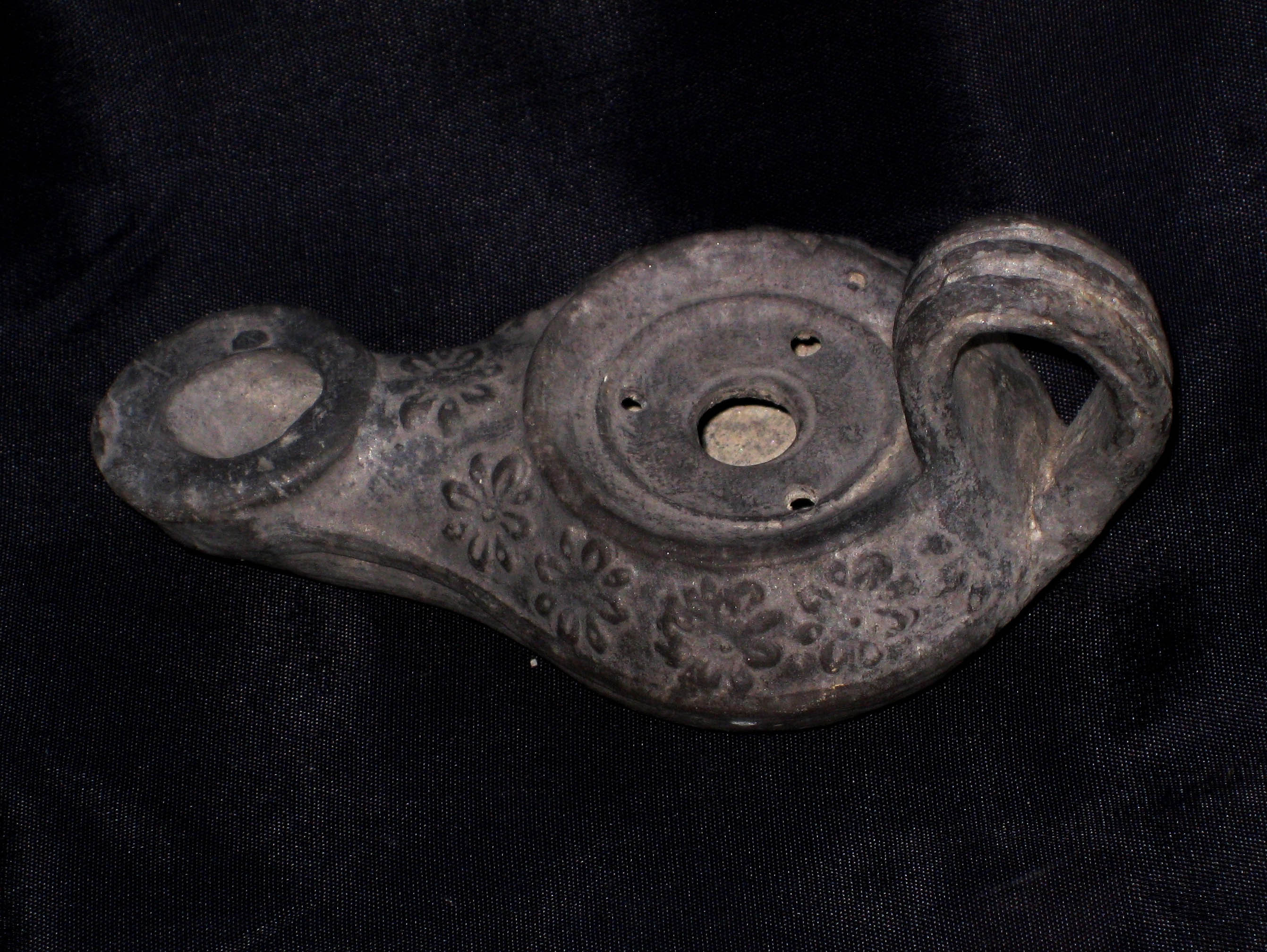
30. Punic Wheel-made Oil Lamp. Second Century BCE.
30. Punic wheel-made saucer lamp with two nozzles, 2nd century BCE. QEDEM 8.274 and 275; Hayes 2.
Comment: The two-nozzled and three-nozzled Punic lamps descend from earlier Palestinian saucer lamps and are related to the pinched-bowl "Hasmonaean" lamp, which is also found in North Africa.


31. Hasmonaean Oil Lamp. Second-First Century BCE.
31. Hasmonaean pinched bowl lamp, red clay, 2nd-1st century BCE. Adler 37-40; Hayes 4 & 5; Israeli & Avida 4 & 5; QEDEM 8.329, 330; Kennedy 481 (1); Negev & Gibson, p. 400.
Comment: The Hasmonean pinched bowl lamp is the final form of the saucer lamps that began in the Middle Bronze Age. Rosenthal and Sivan note that this lamp type is known not only in Palestine but also in Cyprus and Punic North Africa, where double and triple-nozzled lamps of closely related design were also used.


32. Hasmonaean Oil Lamp. Second-First Century BCE.
32. Hasmonaean pinched bowl lamp, light orange clay. 8.5 cm long, 5.2 cm wide. Sussman 2007, lamps 1560-1566.

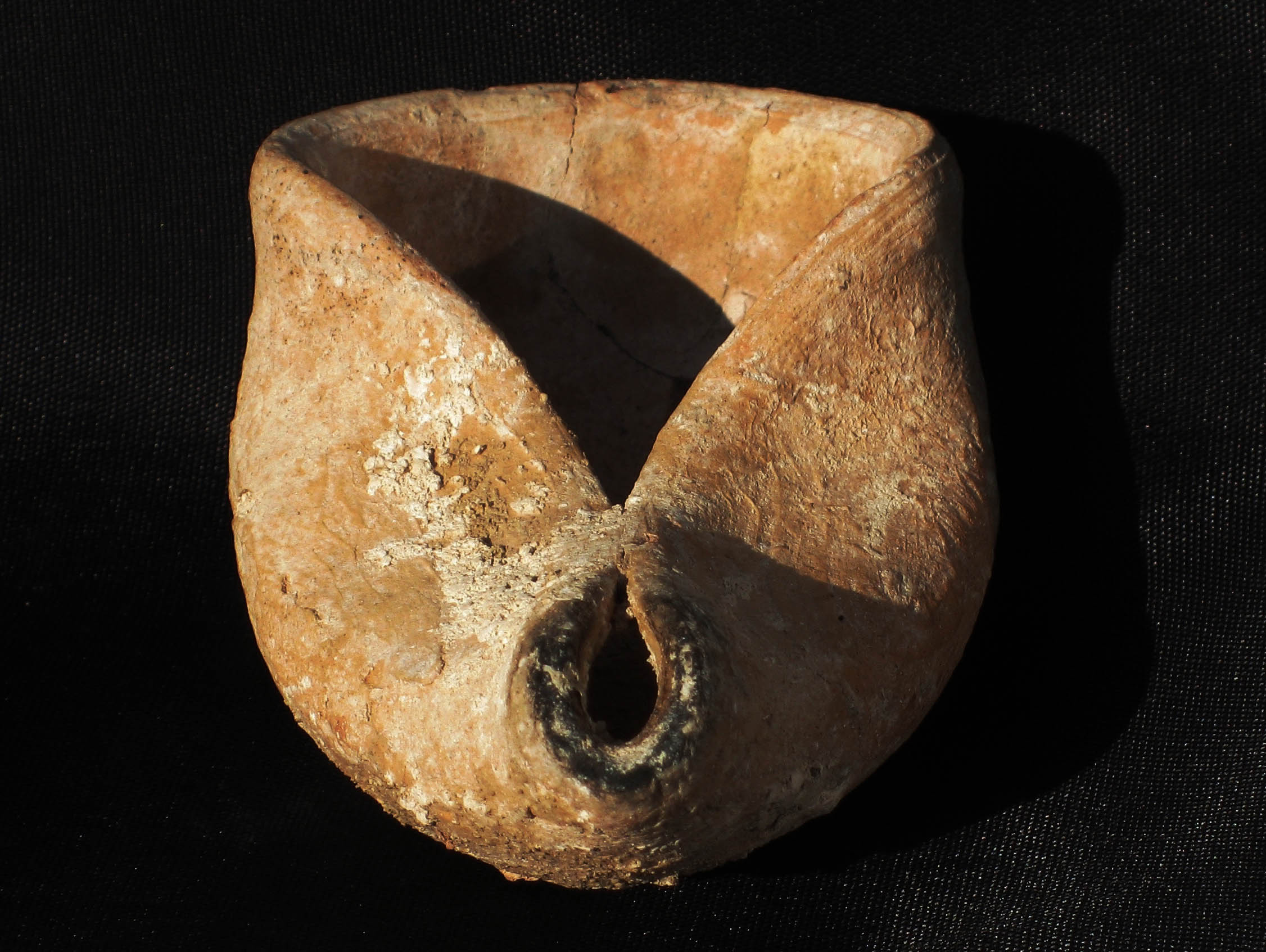

33. Late Hellenistic Radial Oil Lamp. First Century BCE.
33. Late Hellenistic radial lamp of buff-to-tan clay with traces of reddish slip. 8.5 cm long. First half of first century BCE. Adler 59 (similar). Plain filling hole without any trench; sooty wick hole. Nozzle decorated with palm-like pattern of dashes, which also appear on shoulders between radiating line segments. Raised dots and short segments of clay, apparently left by an engraving tool, appear in and at the ends of some of the radial dashes and line segments.


34. Judaean Radial Oil Lamp. First Century BCE.
34. Judaean radial lamp of light red clay with brown slip on upper side with some runs below, 8.5 cm long. Middle third of first century BCE. Rounded body with join between upper and lower parts about two-thirds of its height. Wide rim around filling-hole, decorated with wedge devices and surrounded by a ridge. Low base-ring with central omphalos. Short and broad nozzle decorated with two lines; rounded end; sooty wick-hole. Shoulders decorated with short radial grooves and two palm-like groups of short strokes. Masada Fig. 2, lamps 3, 4 and 10.


IV. Roman Period Lamps
35-43. Herodian Oil Lamps. First Century CE.
Comment: Herodian lamps were made on a potter's wheel, so with careful inspection one can usually see circular striations in the clay. The potter obliterated most of the striations when he rubbed the bottom and sides of the lamp to burnish it and close the pores. However, the potter could not burnish the interior of the lamp, so a spiral design can often be seen in the floor of the lamp as viewed through the filling hole. More minute circular striations can sometimes be found on the shoulders and on the rim and ledge around the filling hole of Herodian lamps.
35. Herodian lamp with pronounced rim and wide ledge around filling hole. Tan clay, 7.8 cm long, 5.8 cm wide. Smith Type 1; Masada C I.


36. Herodian lamp with pronounced rim and wide ledge around filling hole. Pale orange clay, 8.5 cm long. Smith Type 1; Masada C I.


37. Herodian lamp with rim and medium ledge. Red clay, 9.3 cm long. 1st century CE. Smith transitional type; Masada C II.


38. Herodian lamp with rim and medium ledge around filling hole. Orange clay, 8.5 cm long. Smith transitional type; Masada C II.


39. Black Herodian lamp with rim and small ledge around filling hole. Middle third of first century CE. Poorly fired, so losses from flaking. Handle missing. 7.8 cm long, 5.2 cm wide. Adler 142; Smith Type 2; Massada C III (narrow ledge) and C VIII (gray ware with handle, missing).


40. Black Herodian lamp with rim and medium ledge around filling hole. Middle third of first century CE. Concentric circles to either side of wick hole; three more concentric circles run between dotted lines formed by roulette across the nozzle. Vertical handle with triple molding. QEDEM 8.334; Adler 156; Israeli & Avida 84.


41. Herodian lamp with straight sides, rim around the bowl but not the filling hole, a nozzle decorated with a rouletted line and two concentric circles, and a hole to facilitate oil recovery. Circa 50 - 70 CE. Masada C V, lamp 68.


42. Herodian lamp with straight sides, raised rim around the bowl and inset rim around the filling hole, a nozzle decorated with two rouletted lines and two concentric circles, and a hole to facilitate oil recovery. Circa 50 - 70 CE. Masada C V, lamp 68.


43. Two-nozzle Herodian lamp with rim and small ledge around filling hole. Gray clay with cream slip, 10.5 cm long, 8.0 cm wide. Two incised lines on each nozzle, loop handle (missing). 50-150 CE. Adler 127, Israeli & Avida Pl. XI. 58; Masada C IV (large body) and C XI (multiple nozzles); Loffreda lamp 215.


44. Daroma Oil Lamp. 50-100 CE.
44. Daroma mold-made lamp with triangles and lines around filling hole, a ring base, and a knob handle. 50-150 CE. Adler 305.
Comment: Daroma lamps were manufactured in Judaea after the destruction of the Second Temple in 70 CE, when the urban population, including artists and craftsmen, fled Jerusalem. These are essentially the first decorated lamps made by Jews and intended for Jewish use. The sides of the triangles in the motif on my lamp bow outward and probably represent flower petals or leaves of some sort. According to Adler, floral motifs are common on Daroma lamps. Other motifs include agricultural tools, craftsmen's tools, geometric designs, Jewish symbols, and jewelry.


45. Syrian or Lebanese Oil Lamp. 50-100 CE.
45. Non-Jewish lamp of Syrian or Lebanese origin with dolphins flanking the filling-hole, 8.2 cm long. Similar: Smith (1966) Fig. 10, Djuric C167, C168; Adler 471 (Adler Type D.6).


46. Egyptian "Frog Lamp." 50 BCE-150 CE.
46. Egyptian "frog lamp." 50 BCE to 150 CE. Adler 109; BMC I, Q 603 (similar).


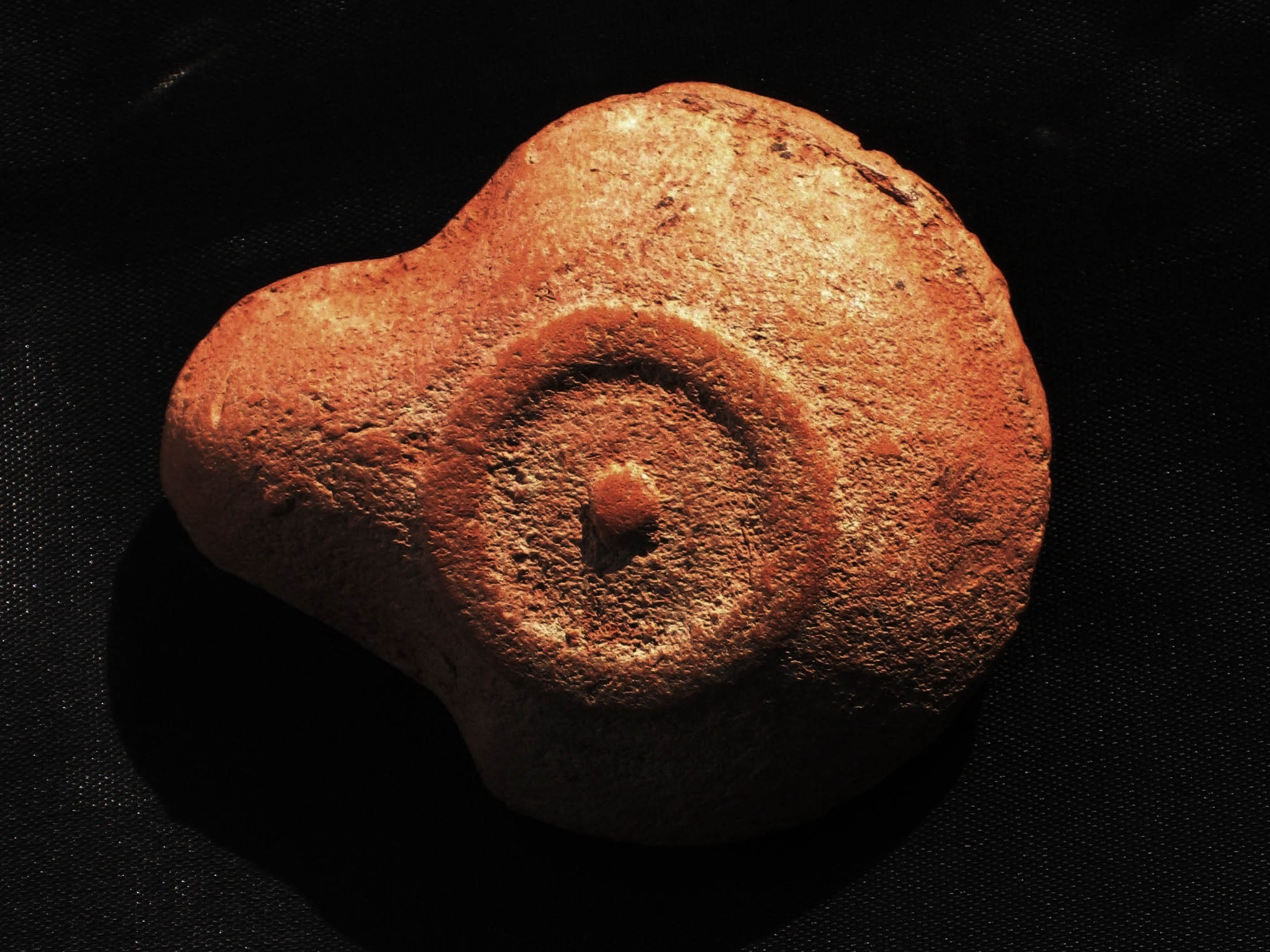
47. Roman Oil Lamp. Second-Third Century CE.
47. Roman provincial lamp from the Levant with a broken discus that had a rosette. 2nd to 3rd century CE. Kennedy Type 5; Hayes lamps 351-356; Israeli & Avida 43-47; Sussman 1985 p. 49.
Comment: Fingerprints, one very wide and sharp, are preserved in the clay on the inside of this lamp. These were made when the clay of the lamp was pressed into the mold by hand.


47A. Kennedy Type 5 lamp featuring Diana holding a bow, hound at feet. 2nd to 3rd century CE. QEDEM 8, lamp 353.


48. Beit Natif Oil Lamp. Late Third-Fifth Century CE.
48. Beit Natif lamp, late 3rd to 5th century CE. Large peacock tail with two circles above it, on nozzle. Plain wide rim around filling hole, encircled by line. Shoulder has a wreath of chevrons ending with encircled pellets; line of dots below. Pyramidal handle, triple ring base. Root marks inside. Adler 516, Israeli & Avida 363.


49. Beit Natif Oil Lamp. Late Third-Fifth Century CE.
49. Beit Natif lamp, late 3rd to 5th century CE. Two sooty wick holes. Quatrefoil loop with raised dots (gold necklace?) on nozzle, voids filled with raised dots. Shoulder has a wreath of chevrons ending with encircled pellets. Pyramidal handle, flat base. Bottom repaired. Adler 563, QEDEM 8.442.


V. Late Antiquity to Modern Period Lamps
50. Early Samaritan Oil Lamp. Fourth-Fifth Century CE.
50. Early Samaritan lamp, bow-shaped nozzle. 4th - 5th century CE. Israeli & Av. 399, Adler 656 (similar).
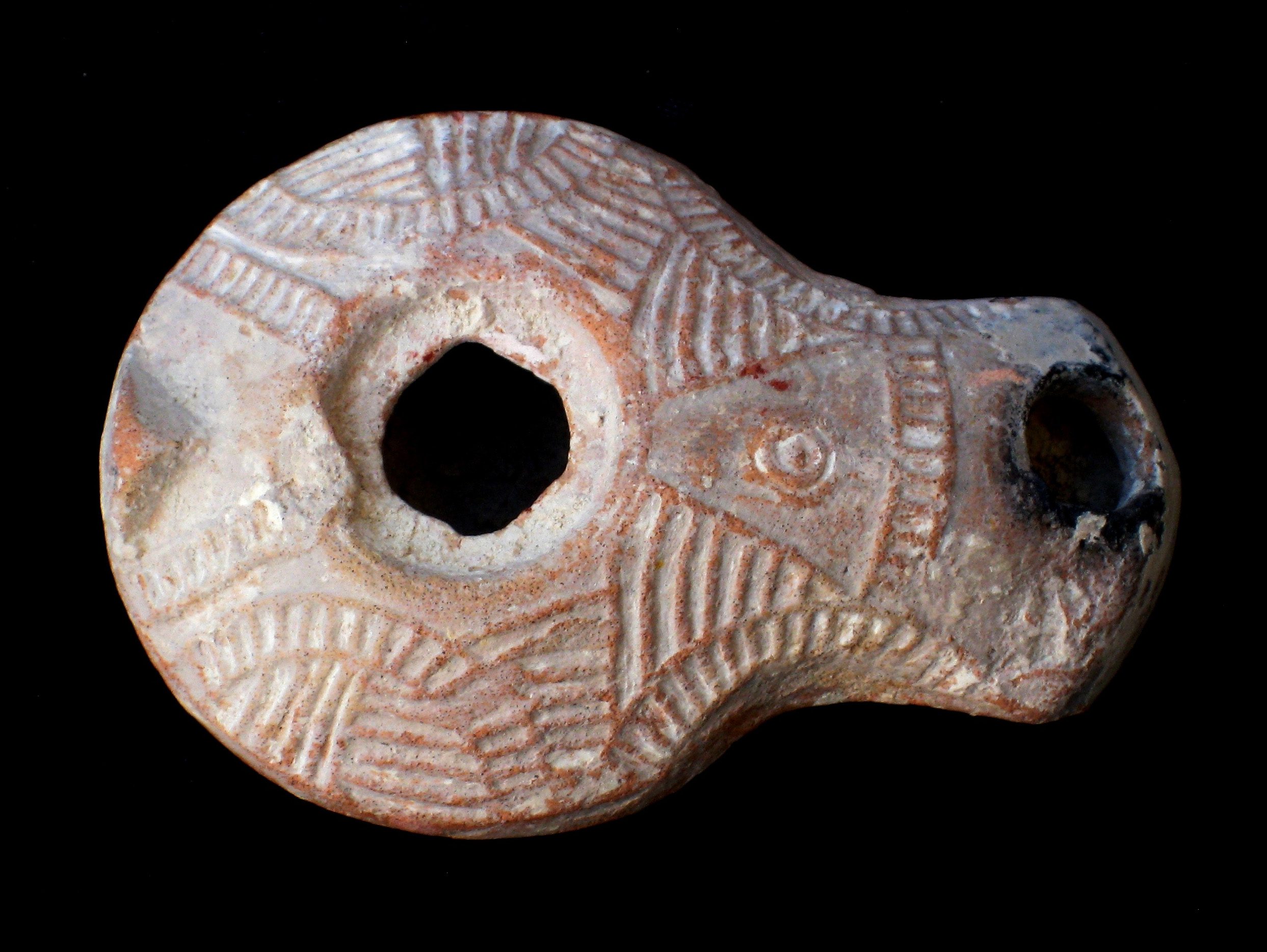

51. Early Samaritan Oil Lamp. Fourth-Fifth Century CE.
51. Early Samaritan lamp, bow-shaped nozzle. 4th - 5th century CE. Pinkish-tan clay. Single-handled and double-handled vessels on shoulders. Branching design (menorah?) on bottom of nozzle. Similar: QEDEM 8.520 & Adler 635 (bottom), Adler 615 (top).


52. North African Redware Oil Lamp. Fourth-Fifth Century CE.
52. North African redware lamp. 4th - 5th century CE. Hayes type I, lamp 285. Lion springing toward handle on discus. Nozzle repaired.


53. North African Redware Oil Lamp. Fifth Century CE.
53. North African redware lamp. Mid to late 5th century CE. Fish on discus. Hayes type IIA, lamps 288-289 (similar); Herrman & Van Den Hoek object 102 (similar).


54. Byzantine "Candlestick" Oil Lamp. Fifth-Seventh Century CE.
54. Byzantine "Candlestick" lamp. 5th-7th century CE. QEDEM 8.476-479; Sussman (1985) p. 49.


55. Inscribed Byzantine "Candlestick" Oil Lamp Fifth-Eighth Century CE.
55. Inscribed Byzantine "Candlestick" lamp with Greek inscription, "The light of Christ shines on all." 8.9 cm long, 6.2 cm wide, and 3.0 cm high. End of 5th to early 8th century CE. Loffreda p. 19 lamp 18; Adler 936.
Comment: To either side of the stylized palm tree(?) are two devices which Loffreda considers symbols representing flights of steps descending into and ascending out of a baptismal pool. 


56. Inscribed Byzantine "Candlestick" Oil Lamp. Fifth-Eighth Century CE.
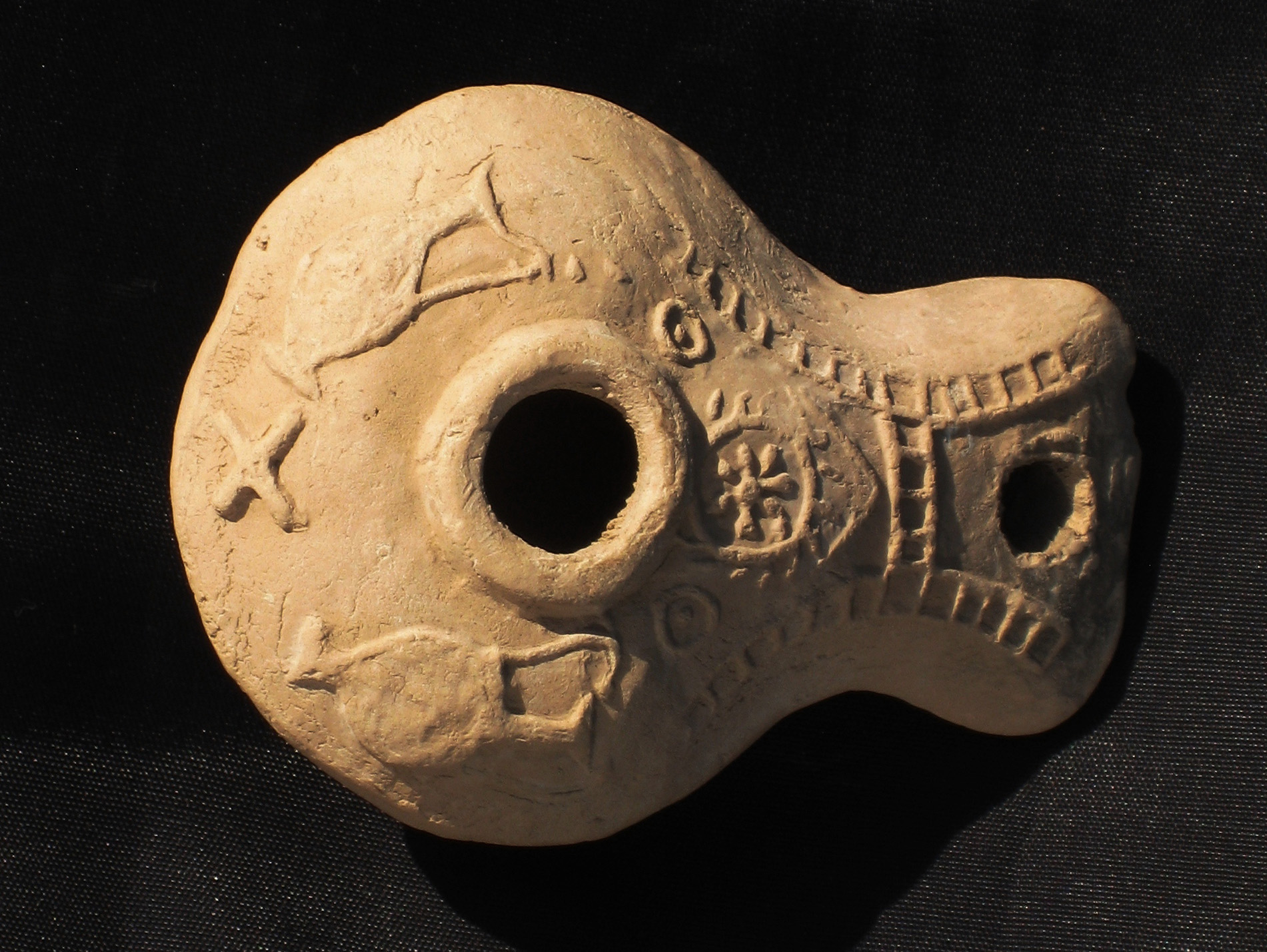
56. Byzantine "Candlestick" lamp with Greek inscription, "The Lord Christ Is My Light." 5th to early 8th century CE. Loffreda p. 22, lamps 32, 33, & 35 (similar).
Comment: There is no exact match in Loffreda. The inscription runs counterclockwise around the lamp. I believe the much-abbreviated text begins with the Χ to the left of the nozzle and reads:
Χ /// ΚC Τ Ε (on side) Ο(open) Φ Ο (instead of omega)
C Μ (defective) Υ . In full, I believe the text is ΧΡΙΣΤΟC ΚΥΡΙΟC ΤΟΕΙΝΑΙ Ο ΦΟC ΜΟΥ. [Xristos = Christ, Kurios To = the Lord, Einai = is, O Fws Mou = the light of me (my light).]


57. Byzantine Oil Lamp. Sixth-Eighth Century CE.
57. Byzantine lamp with laurel on shoulder and cross on nozzle, a false ring base, and a rounded nozzle. 6th-8th century CE. Israeli & Avida 481, 486 (similar).
Comment: Fingerprints are visible inside the lamp.


58. Byzantine "Boot" Lamp. Sixth-Seventh Century CE.
58. Byzantine wheel-made "boot" style lamp. 6th - 7th century CE. QEDEM 8.506, 507; Israeli & Avida 500; Adler 950, 951; Sussman 1982, p. 12; Kennedy 630 (16).
Comment: The handle of my Byzantine "boot" lamp broke in ancient times. A thick layer of minerals overlies the break, so that the sharp edges of the actual break are well-hidden. This lamp was made from coarse clay and though it was decorated with grooves, it was given no surface treatment whatsoever. This lamp type is more common in southern Israel than in the north (per Adler). Incidentally, after wheel-made lamps were abandoned in early Roman times as mold-made lamps swept them from the market, they now make a comeback and will continue to be made through the Islamic period and into the Middle Ages.


59. Islamic Mold-made Oil Lamp. Seventh-Ninth Century CE.
59. Islamic mold-made lamp with geometric pattern of radial lines on the shoulders, a conical handle, a ring base, and a pointed nozzle. 7th to 9th century CE. Israeli & Avida, lamps 446-452 (similar); Qedem Reports 4, Type 36.40.
Comment: According to Israeli & Avida, the production and distribution of this lamp type included Syria and Eretz Israel.


60. Islamic Mold-made Oil Lamp. Eighth Century CE.
60. Islamic mold-made lamp copying wheel-made pattern, closed with a sharply pointed tip under the wick-hole and a horizontally pierced handle at the rear. 8th century CE or later. Hayes 349; Adler 1015; Djuric C339-C343.


61. Islamic Unglazed Wheel-made Oil Lamp. Twelfth-Thirteenth Century CE.
61. Islamic unglazed wheel-made lamp with high, flaring sides folded to make a long triangular wick rest and a sharply curved handle connecting the back rim to a small, sharp-edged pan in the bottom of the lamp. Crusades Period (12th to 13th century CE), Djuric C353; Kennedy 799 (26) is similar.
Comment: According to Kennedy, although Crusader lamps from other locations may have a green or brown glaze, Palestinian examples are never glazed.


62. Islamic Unglazed Wheel-made Oil Lamp. Twelfth-Nineteenth Century CE.
62. Islamic unglazed relatively small wheel-made lamp with deep bowl and string-cut flat base. 12th to 19th century CE. Qedem Reports 4, Type 51 (lamp 499).
Comment: This lamp resembles Iron Age lamps but the profile of the wall is very different, rising from the floor at a 45 degree angle and with only a slight S-shaped carination from floor to rim. The lamp is also much smaller and is made of thinner fabric than most Iron Age lamps are.


- - - - - - - - - - - - - -
OIL LAMP REFERENCES
Adler, Noam. A Comprehensive Catalog of Oil Lamps of the Holy Land from the Adler Collection. Old City Press: Israel, 2004.
Bailey, D. M. A Catalogue of the lamps in the British Museum: I: Greek, Hellenistic, and Early Roman Pottery Lamps. British Museum Publications: London, 1975.
Baur, P. V. C. (Rostovtseff et al., editors). The Excavations at Dura-Europos Conducted by Yale University and the French Academy of Inscriptions and Letters: Final Report IV: Part III: The Lamps. Yale University Press: New Haven, 1947.
Djuric, Srdjan. The Anawati Collection, Catalog 1: Ancient Lamps from the Mediterranean. Eika Bookselling and Publishing: Toronto, 1995.
Hadad, Shulamit. Excavations at Bet Shean: Volume I: The Oil Lamps from the Hebrew University Excavations at Bet Shean. (QEDEM Report 4). Hebrew University of Jerusalem: Jerusalem, 2002.
Hayes, J. W. Ancient Lamps in the Royal Ontario Museum I: Greek and Roman Clay Lamps: A Catalogue. Royal Ontario Museum: Toronto, 1980.
Herrmann, John J. Jr., and Van Den Hoek, Annewies. Light from the Age of Augustine: Late Antique Ceramics from North Africa (Tunisia). Harvard Divinity School: Cambridge, 2002.
Israeli and Avida. Oil Lamps from Eretz Israel: The Louis and Carmen Warschaw Collection at the Israel Museum, Jerusalem. The Israel Museum: Jerusalem, 1988.
Kennedy, C. A. The Development of the Lamp in Palestine. In Berytus. Volume XIV: 1963.
Loffreda, Stanislao. Light and Life: Ancient Christian Oil Lamps of the Holy Land. Franciscan Printing Press: Jerusalem, 2001.
Perlzweig, Judith. Lamps from the Athenian Agora. American School of Classical Studies at Athens: Princeton, New Jersey, 1963.
Rosenthal and Sivan. QEDEM Monographs of the Institute of Archaeology, The Hebrew University of Jerusalem, #8: Ancient Lamps in the Schloessinger Collection. Ahva Press: Jerusalem, 1978.
Smith, R. H. Series of three articles in The Biblical Archaeologist. Volume 27, No. 1, pp. 1-31 (1964); Volume 27, No. 4, pp. 101-124 (1964); Volume 29, No. 1, pp. 2-27 (1966).
--. The ‘Herodian’ Lamp of Palestine: Types and Dates. In Berytus. Volume XIV, Number 1: 1961.
Sussman, Varda. Lighting the Way Through History: The Evolution of Ancient Oil Lamps. Biblical Archaeology Review. Volume XI, No. 2: March/April 1985.
--. Oil-Lamps in the Holy Land: Saucer Lamps: From the Beginning to the Hellenistic Period: Collections of the Israel Antiquities Authority. Archeopress: Oxford, 2007.
--. Ornamented Jewish Oil-Lamps from the Destruction of the Second Temple through the Bar Kochba Revolt. Arist Phillips: Warminster, England, 1982.
Westenholz, Joan. Goodnick, ed. Let There Be Light: Oil Lamps from the Holy Land. Bible Lands Museum: Jerusalem, 2004.
OTHER REFERENCES
Aharoni, Yohanan. Archaeology of the Land of Israel: From the Prehistoric Beginnings to the End of the First Temple Period. Philadelphia: Westminster Press, 1982.
Albright, William Foxwell. The Excavation of Tell Beit Mirsim: Volume I: The Pottery of the First Three Campaigns. New Haven, NJ: American Schools of Oriental Research, 1932.
Amiran, Ruth. Ancient Pottery of the Holy Land. New Brunswick, NJ: Rutgers University, 1970.
Avigad, Nahman. She'arim: Report on the Excavations During 1953-1958: Volume III: Catacombs 12-23. Massada Press: Jerusalem, 1976.
Bartlett, John R. Cities of the Biblical World: Jericho. Eerdmans: Grand Rapids, Michigan, 1982.
Ben-Tor, Amnon (Ed.). The Archaeology of Ancient Israel. Yale University Press: New Haven, 1992.
--. Yoqne’am I: The Late Periods (QEDEM Report 3). Hebrew University of Jerusalem: Jerusalem, 1996.
--. Yoqne’am II: The Iron Age and the Persian Period: Final Report of the Archaeological Excavations (1977-1988) (QEDEM Report 6). Hebrew University of Jerusalem: Jerusalem, 2005.
Biram, Avraham. Biblical Dan. Hebrew Union College-- Jewish Institute of Religion: Jerusalem, 1994.
Hendrix, Ralph E. et al. Ancient Pottery of Transjordan: An Introduction Utilizing Published Whole Forms, Late Neolithic through Late Islamic. Andrews University Press, Berrien Springs, Michigan: 1996.
Kenyon, Kathleen. Jerusalem: Excavating 3000 Years of History. McGraw-Hill: New York, 1967.
--. Archaeology in the Holy Land (3rd edition). Praeger Publishers: New York, 1970.
Loffreda, Stanislao. Holy Land Pottery at the Time of Jesus: Early Roman Period 63 BC - 70 AD. Franciscan Printing Press: Jerusalem, 2002.
Moscati, Sabatino (Ed.). The Phoenicians / Under the Scientific Direction of Sabatino Moscati. Abbeville Press: New York, 1988.
Negev, Avraham and Gibson, Shimon. Archaeological Encyclopedia of the Holy Land. Continuum: New York, 2001.
Reisner, George A. et al. Harvard Excavations at Samaria 1908 - 1910, Volumes I & II. Harvard University Press: Cambridge, 1924.
Stern, Ephraim. The Material Culture of the Land of the Bible in the Persian Period 538-332 BC. Aris & Philips Ltd.: Warminster, England, 1982.
Ussishkin, David. The Renewed Archaeological Excavations at Lachish (1973-1994), Volumes I - V. Tel Aviv University: Tel Aviv, 2004.
Wachsmann, Shelley. The Sea of Galilee Boat: A 2000 Year Old Discovery From the Sea of Legends. Perseus Books: New York, 2000.
Wood, Bryant G. The Sociology of Pottery in Ancient Palestine: The Ceramic Industry and the Diffusion of Ceramic Style in the Bronze and Iron Ages. Sheffield Academic Press: Sheffield, England, 1990.
Yadin, Yigael et al. Hazor I: An Account of the First Season of Excavations, 1955. Magness Press: Jerusalem, 1955.
--. Hazor II: An Account of the Second Season of Excavations, 1956. Magness Press: Jerusalem, 1956.
--. Hazor III-IV: An Account of the 3rd & 4th Seasons of Excavations, 1957-1958. Magness Press: Jerusalem, 1958.
--. Hazor: The Rediscovery of a Great Citadel of the Bible. New York: Random House, 1975.
Background Resources